Picture this: It’s 22 degrees outside, your car is covered in road salt, and you’re wondering if anyone in their right mind would want to buy it. You’ve heard the whispers, winter is the worst time to sell, but your inspection sticker expires next month, your truck needs new tires, and frankly, you’d rather have instant cash for cars than deal with another New England snowstorm behind the wheel of a vehicle you’re done with.
Here’s the truth that dealerships don’t advertise and generic selling guides completely miss: winter in Enfield CT and Springfield MA is actually one of the smartest times to sell certain vehicles, especially if you know what local buyers are hunting for and how to position your car, truck, or SUV to stand out. Whether you’re looking to sell my car for cash near Enfield, CT or sell my car for cash near Springfield, MA, understanding the seasonal dynamics of the Connecticut-Massachusetts border market can mean the difference between a lowball offer and top dollar.
The real question isn’t “Should I wait until spring?” It’s “What do I need to know right now to maximize my cash offer for car before February hits?” Let’s dig into what actually moves fast in winter, what kills your value, and how to get an instant cash offer for car while the market is still hot for the right inventory.
Key Takeaways
- AWD/4WD vehicles, SUVs, and trucks see peak demand in Connecticut and Massachusetts during December and January, often commanding stronger trade-in values than spring months
- Waiting until spring can cost you money through continued depreciation, insurance, registration fees, and potential winter damage that reduces appraisal value
- Local appraisals typically yield better offers than sight-unseen national services because inspectors can verify condition rather than applying blanket winter deductions
- Rust, tire condition, and battery health are the top three value-killers that appraisers focus on during winter inspections in New England
- You can boost your offer in under 30 minutes by gathering documentation, taking quality photos, and addressing obvious cosmetic issues before your appraisal
The Winter Selling Myth (And What’s True in Enfield–Springfield)
Every January, the same tired advice circulates: “Don’t sell your car in winter—nobody’s buying.” That guidance might hold water in Florida or Arizona, where seasonal swings are minimal. But here in the Enfield-Springfield corridor? It’s dangerously oversimplified and often flat-out wrong.
The reality is more nuanced. Yes, overall new-vehicle sales volume drops in January, forecasts for January 2026 show sales finishing around 15.3 million units on a seasonally adjusted annual rate, down from December’s 16.1 million level, representing a 23.5% decline following the holiday shopping season[3]. But that national trend masks a critical local truth: need-based demand for specific vehicle types actually spikes during New England winters.
Why Buyers Still Shop in January (Need-Based Demand)
Winter car shopping in Connecticut and Massachusetts isn’t driven by casual browsing—it’s driven by necessity. Consider these common scenarios playing out right now across Hartford and Hampden counties:
The Stranded Commuter: Someone’s 2015 Honda Civic with bald all-season tires just slid into a curb on Route 5 during last week’s ice storm. They need a replacement today, not in April. They’re specifically searching for AWD or 4WD vehicles that can handle the next ten weeks of winter.
The Growing Family: A couple in Longmeadow just had their second child and realized their sedan can’t fit two car seats plus a stroller. They need a three-row SUV sport utility vehicle or crossover and they need it before the next pediatrician appointment in a snowstorm.
The Side-Hustle Worker: A contractor in Enfield needs to replace their aging pickup that finally gave up the ghost. Plow season is happening right now, and every day without a truck is lost income.
These buyers aren’t price-shopping for fun, they’re solving urgent problems. That urgency translates into stronger offers for the right inventory. Winter demand for AWD and 4WD vehicles in Connecticut peaks in December and January, creating strong trade-in values for rugged vehicles, SUVs, and trucks during this period.
Meanwhile, if you’re trying to sell my truck or sell my suv sport utility vehicle in May, you’re competing with every other seller who waited for “better weather”, flooding the market and driving prices down.
Why Waiting Can Cost Money (Depreciation + Carrying Costs)
Let’s talk real numbers. Say you’re holding a 2019 Toyota RAV4 with 68,000 miles. You’re thinking, “I’ll wait until April when buyers are out in force.” Here’s what that three-month delay actually costs you:
| Expense Category | 3-Month Cost (Jan-Apr 2026) |
|---|---|
| Depreciation (avg. 1% monthly) | $240-$360 |
| Insurance (full coverage) | $375-$525 |
| Registration/property tax (CT) | $0-$180 (if renewal due) |
| Maintenance/repairs | $150-$400 (oil change, inspection, misc.) |
| Total Carrying Cost | $765-$1,465 |
That’s money you’re spending to own a vehicle you’ve already decided to sell. And we haven’t even factored in the risk of winter damage, a fender-bender in a parking lot, new rust from road salt, or a dead battery that needs replacement.
Trade-in values hold better when vehicles are appraised before harsh winter conditions take a toll on tires, exterior condition, and underbody wear[2]. Every week you wait is another week of exposure to the elements that New England appraisers will notice and will deduct for.
The local car appraisal professionals in Enfield have seen this pattern repeatedly: sellers who act in January typically net more than those who wait until the spring rush, even after accounting for seasonal market fluctuations.
What Sells Best in Winter Around Here
Not all vehicles are created equal when snow is on the ground. Understanding what moves fast—and what sits on lots gathering frost—is critical to timing your sale correctly. If you want to sell my car for cash today near me in the Enfield-Springfield market, you need to know where your vehicle fits in the winter demand hierarchy.
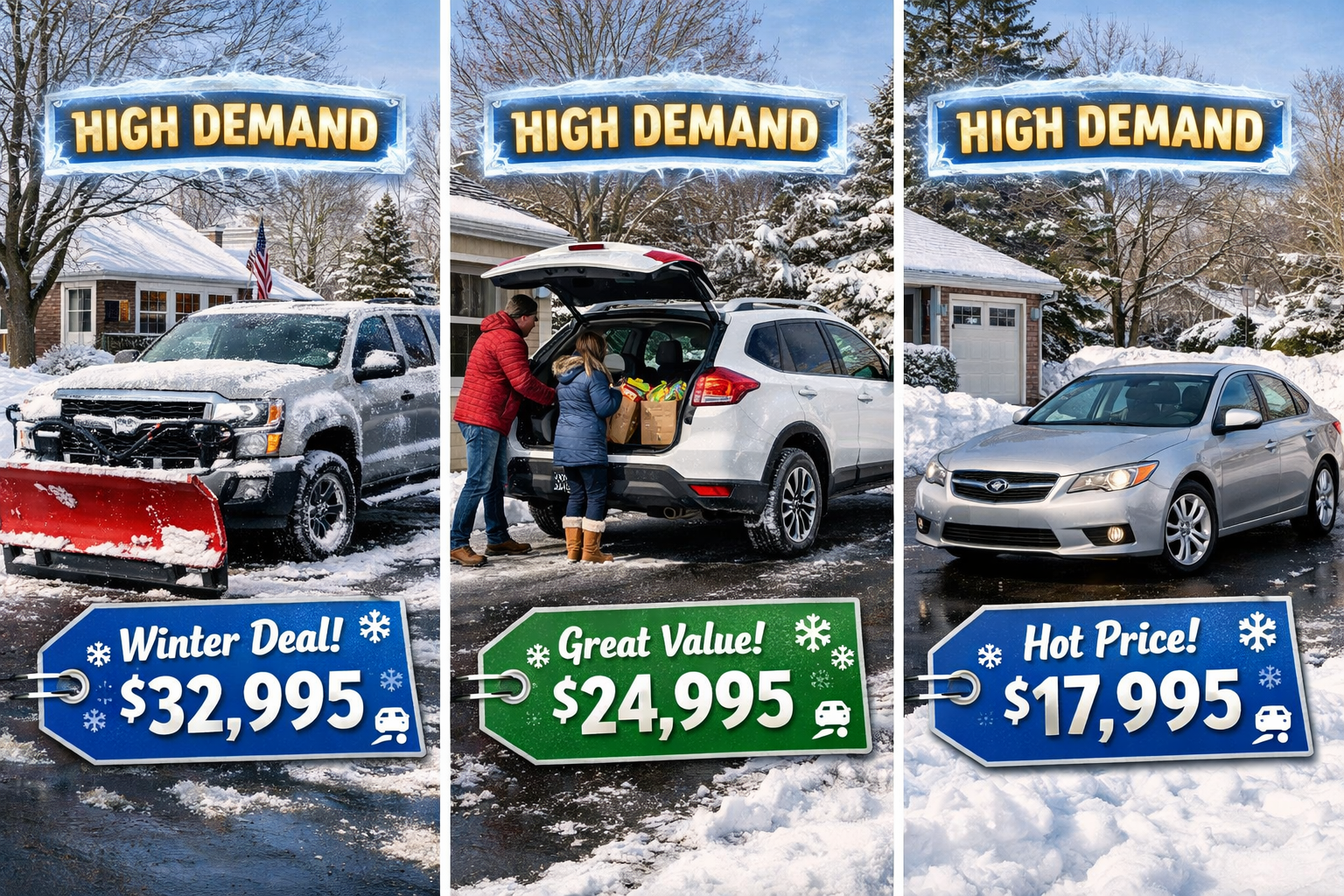
AWD/4WD Vehicles (SUVs, Crossovers, Trucks)
This is the golden category. All-wheel drive and four-wheel drive vehicles are winter royalty in New England. Buyers actively seek them out, often willing to pay premium prices to secure reliable winter transportation.
Top performers include:
- Subaru Outback, Forester, Crosstrek: The unofficial state vehicle of Connecticut. These practically sell themselves in January.
- Toyota RAV4, Highlander, 4Runner: Legendary reliability meets winter capability. High resale value year-round, but especially strong in winter months.
- Honda CR-V, Pilot: Family-friendly AWD with Honda’s reputation for longevity.
- Jeep Wrangler, Grand Cherokee: Off-road capability translates to winter confidence.
- Ford F-150, Chevy Silverado, RAM 1500 (4WD): Work trucks with four-wheel drive command top dollar, especially if they’re plow-ready.
A real-world example: In December 2025, a 2018 Subaru Forester with 55,000 miles listed in Enfield received three cash offer for car inquiries within 48 hours. The same vehicle listed in May typically sits for 2-3 weeks. Why? Because January buyers need AWD now, not eventually.
Connecticut’s winter market shows peak demand for vehicles with updated safety technology and better winter capability, affecting which vehicles command higher appraisal values[1]. If your vehicle has features like heated seats, remote start, or advanced traction control, make sure those are highlighted in your listing or mentioned during your online car appraisal.
Dependable Commuters (Reliable Sedans/Hatches)
Don’t write off front-wheel-drive sedans entirely. While they don’t command the premium that AWD vehicles do, reliable, fuel-efficient commuters still sell steadily to budget-conscious buyers who need basic winter transportation.
Strong winter sellers:
- Honda Civic, Accord: Proven winter reliability with good resale value
- Toyota Corolla, Camry: Low maintenance costs attract practical buyers
- Mazda3: Fun-to-drive with better-than-average winter handling
- Hyundai Elantra, Kia Forte: Warranty coverage appeals to risk-averse buyers
The key differentiator? Condition and maintenance records. A well-maintained 2017 Honda Civic with new tires and documented oil changes will move faster than a neglected 2019 model with mystery stains and no service history.
If you’re trying to sell my car for cash near Springfield, MA and your vehicle falls into this category, emphasize reliability factors: recent battery replacement, winter tires included, clean CARFAX, etc. These details matter more in winter when buyers are risk-averse.
“Work Vehicles” (Plow-Ready, Tow-Capable Setups)
This is a specialized but highly lucrative winter niche. Trucks and SUVs equipped for commercial use see exceptional demand from January through March as contractors, landscapers, and snow-removal services scramble to keep their fleets operational.
Premium features that boost winter value:
- Plow mounts already installed (even if you’re not including the plow itself)
- Tow packages with brake controllers
- Bed liners and toolbox setups
- Heavy-duty suspension upgrades
- Diesel engines (especially in F-250/F-350 class trucks)
A 2016 Ford F-250 with a plow mount and 80,000 miles can command $3,000-$5,000 more in January than in June simply because buyers need it right now for active contracts. If you’re looking to sell my pickup with commercial features, winter is absolutely your season.
Pro tip: If you’ve used your truck for plowing, be upfront about it. Experienced buyers expect some wear, but they also value proven capability. Trying to hide commercial use usually backfires during inspection.
The Winter Value-Killers Appraisers Notice
Now for the hard truth: winter exposes vehicle problems that might hide in summer. Professional appraisers in Connecticut and Massachusetts know exactly where to look, and they’re trained to spot issues that significantly impact value. Understanding these common deductions helps you either address them beforehand or set realistic expectations.
Rust Hotspots (Rockers, Frame, Brake Lines)
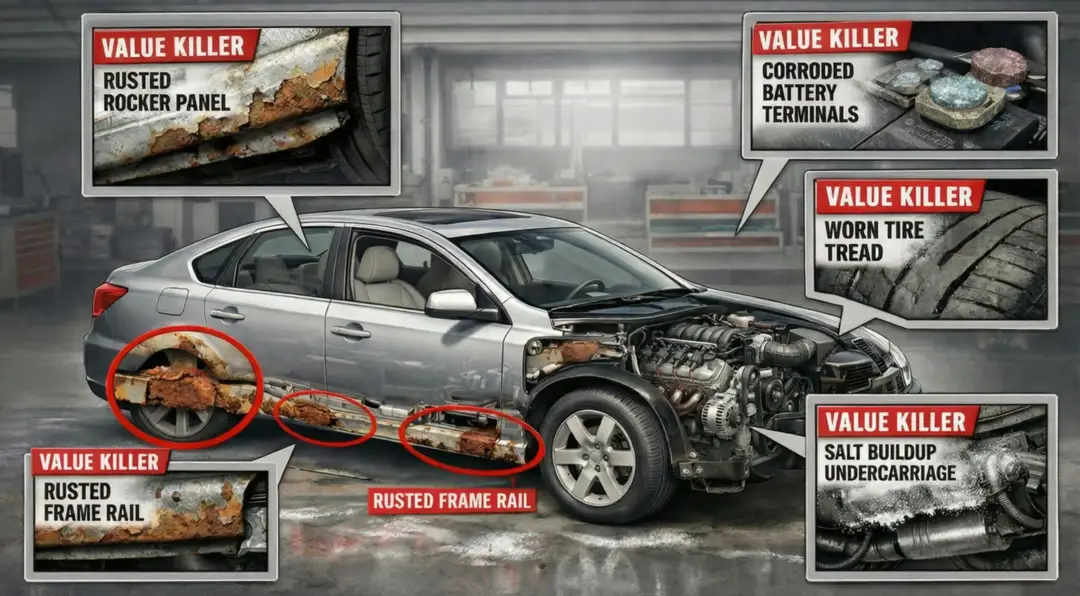
This is the big one, the value-killer that separates New England vehicles from their Sun Belt cousins. Road salt is brutally corrosive, and appraisers check specific areas where rust typically starts:
Critical inspection points:
- Rocker panels (the body panels below the doors): Surface rust here is common; structural rust is a major deduction
- Frame rails (especially near rear suspension mounts): Frame rust can make a vehicle unsafe and nearly unsellable
- Brake lines: Corroded brake lines are a safety issue and immediate red flag
- Wheel wells and fender liners: Trapped salt and slush create perfect rust conditions
- Exhaust system hangers and brackets: Often overlooked but checked by thorough inspectors
What to do about it:
- Don’t try to hide rust with spray paint or undercoating applied the day before inspection. Appraisers see this constantly and it destroys trust.
- Be honest and upfront. Surface rust on a 7-year-old Connecticut vehicle is expected; structural rust needs disclosure.
- Get underneath with a flashlight before your appraisal and document what you find. If you’re surprised by rust during inspection, the appraiser will assume you’ve neglected other maintenance too.
Winter weather damage—including salt, snow, and ice impact—reduces vehicle condition and can negatively affect appraisal values, creating incentive for sellers to trade in before deep freeze conditions worsen[2]. If you’re planning to sell my car for cash near Enfield, CT in February, consider getting your appraisal done now before another month of salt exposure.
Tires (All-Season vs Winter Tread Depth)
Tires are the second thing appraisers inspect—and in winter, they matter even more. Here’s what they’re evaluating:
Tread depth standards:
- New tires: 10/32″ to 12/32″ tread depth
- Good condition: 6/32″ or more (passes inspection, good value)
- Marginal: 4/32″ to 5/32″ (legal but will need replacement soon—expect $400-$800 deduction)
- Unsafe: 3/32″ or less (immediate replacement needed—expect $600-$1,000+ deduction)
Winter tire bonus: If your vehicle comes with a second set of mounted winter tires, that’s a $400-$800 value-add in the Enfield-Springfield market. Make sure to mention this during your appraisal.
Mismatched tires penalty: Four different tire brands or significantly different tread depths suggest deferred maintenance and typically result in a $200-$400 deduction beyond the cost of replacement.
The simple tread-depth test: Insert a quarter into the tread groove with Washington’s head upside down. If you can see the top of his head, your tread is below 4/32″ and you’re looking at a deduction.
Battery/Starting Issues + Warning Lights
Cold weather is a battery stress test and appraisers know it. A battery that struggles to start at 20°F is a battery that’s about to fail. Here’s what triggers deductions:
Battery red flags:
- Slow cranking when starting (classic sign of weak battery)
- Corrosion on terminals (suggests poor maintenance)
- Battery age over 4 years in New England climate (expected lifespan is 3-5 years)
- Voltage below 12.4V when tested (indicates charge issues)
Replacement cost deduction: $150-$250 for standard batteries, $200-$400 for AGM batteries in newer vehicles.
Dashboard warning lights are instant value-killers regardless of season:
- Check Engine Light: $200-$1,500 deduction depending on code severity (get it diagnosed before appraisal)
- ABS/Traction Control lights: $300-$800 deduction (safety system issues are serious)
- Airbag light: $500-$1,200 deduction (major safety concern)
- TPMS light: $50-$150 deduction (minor but still noted)
Pro strategy: If you have a check engine light, spend $50 at AutoZone to get the code read. If it’s something minor (like an EVAP code from a loose gas cap), fix it. If it’s major (like a catalytic converter), disclose it upfront and adjust your price expectations. Surprises during inspection always cost more than honest disclosure.
For more detailed guidance on preparing your vehicle, check out these selling your car tips that cover year-round best practices.
7 Things You Can Do in 30 Minutes to Boost Your Offer
You don’t need a full detail and professional reconditioning to improve your appraisal value. Strategic, focused effort in the right areas can add $200-$500 to your offer, and it takes less time than watching a Netflix episode. Here’s your quick-win checklist.
Quick Clean-Out + Wipe-Down (Photos Matter)
Time investment: 15 minutes
First impressions matter enormously, especially for online appraisals where photos drive the initial offer. You’re not trying to make your car showroom-perfect; you’re trying to show it’s been cared for.
The 15-minute clean:
-
Remove all personal items: Phone chargers, air fresheners, parking passes, trash, kids’ toys—everything. Empty vehicles photograph better and signal “ready to sell.”
-
Vacuum front and rear floors: Focus on visible dirt and debris. Don’t worry about shampooing stains; just remove the obvious stuff.
-
Wipe down dashboard and center console: Use a damp microfiber cloth (or even a baby wipe). Remove dust, fingerprints, and any sticky residue.
-
Clean windows inside and out: Streak-free glass makes a dramatic difference in photos and in-person impressions.
-
Trunk/cargo area: Remove spare junk, vacuum out dirt, make sure the spare tire and jack are visible and properly stored.
Why this matters: Appraisers see dozens of vehicles weekly. A clean interior suggests you’ve maintained the mechanical components too. A trash-filled interior suggests neglect—even if your maintenance records are perfect.
Gather Keys, Title/Loan Info, Service Records
Time investment: 10 minutes
Nothing slows down a sale like missing paperwork. Having everything organized before your appraisal signals you’re a serious seller and speeds up the entire process.
Your document checklist:
 Vehicle title (if owned outright) or lienholder information (if financed) All keys and fobs (two sets is standard; one set may result in $150-$250 deduction) Owner’s manual and maintenance booklet (if available) Service records (especially for major work: timing belt, transmission service, etc.) Recent inspection sticker documentation (if applicable) Warranty information (if transferable warranty remains)
Connecticut-specific note: If you’re selling a vehicle in CT, you’ll need to provide a bill of sale and properly transfer the title. The buyer is responsible for sales tax, but you’re responsible for canceling your registration and returning plates to DMV within 30 days to avoid continued property tax liability. More details in our guide to selling a car in Connecticut.
Massachusetts-specific note: MA sellers must complete an RMV-1 form (Application for Registration and Title) and provide the buyer with the certificate of title properly signed. You’ll also need to cancel your insurance and return plates. See our guide to selling a car in Massachusetts for complete requirements.
Loan payoff tip: If you still owe money on your vehicle, call your lender and get the exact 10-day payoff amount. This number changes daily due to interest accrual, so get it in writing. Most cash buyers can handle payoff directly, but you need to know the number to understand your net proceeds.
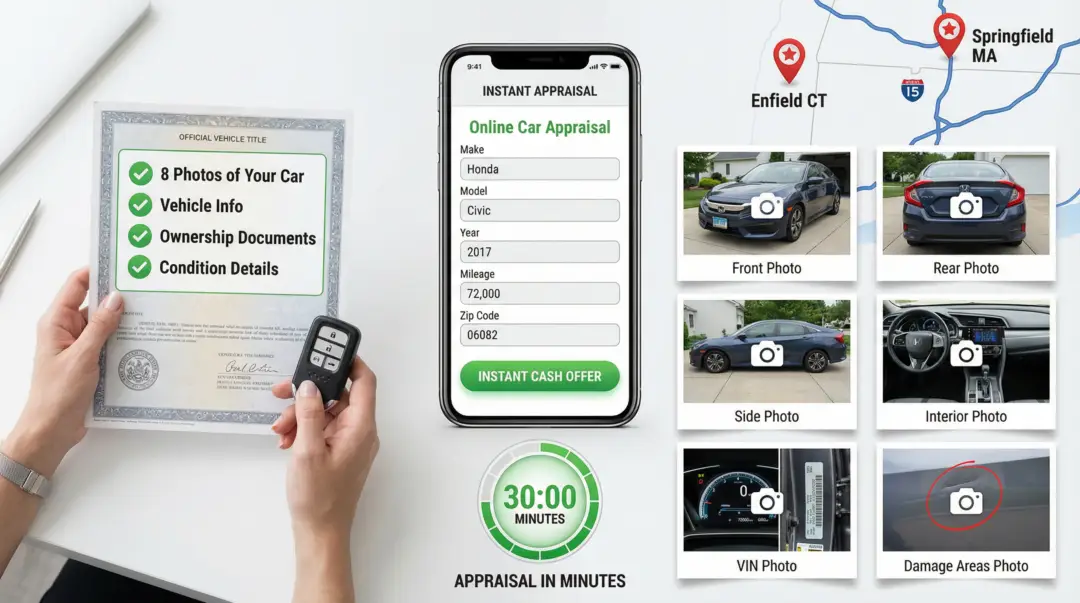
Take 6 to 8 “Appraisal Photos” (Simple Checklist)
Time investment: 5 minutes
If you’re starting with an online appraisal, photo quality directly impacts your initial offer. Poor photos result in conservative offers with large “pending inspection” deductions. Good photos result in accurate offers that hold up during in-person verification.
The 8 essential photos:
- Front 3/4 view (driver’s side): Shows front end and driver’s side in one shot
- Rear 3/4 view (passenger side): Shows rear end and passenger side
- Straight-on driver’s side: Full profile view
- Straight-on passenger side: Full profile view
- Interior dashboard/front seats: Shows condition of driver area
- Interior rear seats: Shows back seat condition
- Odometer reading: Clear, in-focus shot showing exact mileage
- VIN plate: Usually visible through windshield on driver’s side dashboard
Bonus photos if applicable:
- Any damage (dents, scratches, rust spots)—honesty prevents surprises
- Upgraded features (aftermarket stereo, new tires, etc.)
- Engine bay (if exceptionally clean)
- Cargo area/truck bed
Photo tips:
- Shoot in daylight (overcast is actually ideal no harsh shadows)
- Clean the car first (see previous section)
- Use landscape orientation (horizontal photos show more)
- Step back (get the whole vehicle in frame, not extreme close-ups)
- Avoid filters or editing (appraisers want accurate representation)
These photos take five minutes but can mean the difference between a preliminary offer of $8,500 and $9,200. The higher offer comes from confidence in condition, which comes from clear documentation.
Fastest Way to Get a Winter Offer (Local vs National)
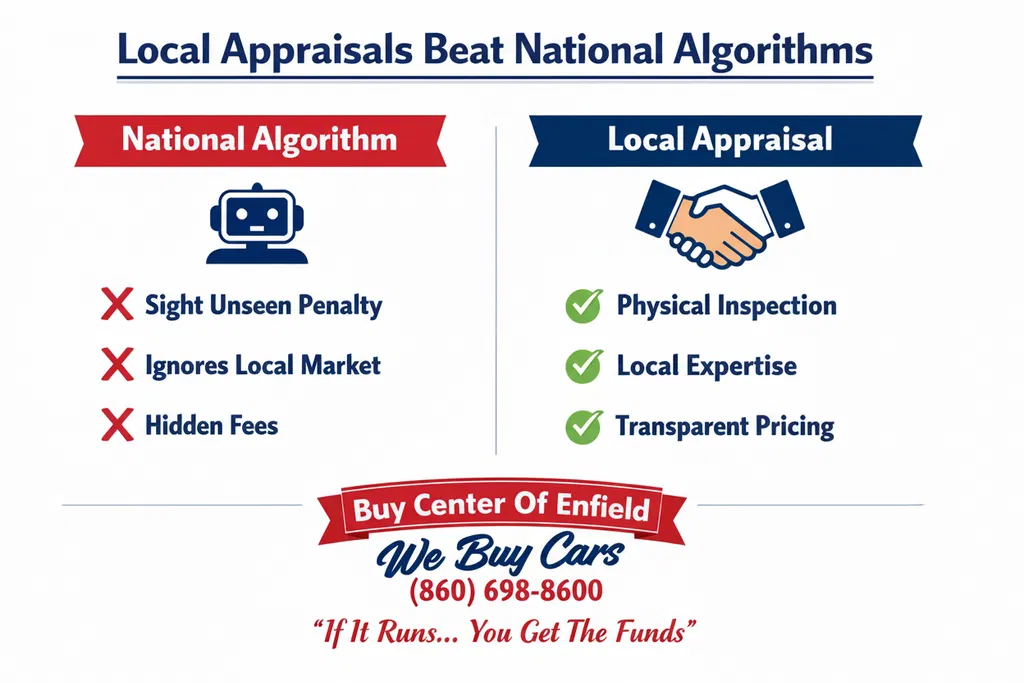
You’ve got options when it comes to getting an instant cash offer for car in the Enfield-Springfield area. Understanding the trade-offs between local buyers and national services helps you choose the path that maximizes value while minimizing hassle.
Why Local Verification Can Reduce “Sight-Unseen” Deductions
National online car buyers (Carvana, Vroom, CarMax, etc.) operate on a standardized model: you submit photos and vehicle details, they generate an algorithmic offer, and then they inspect in person to verify condition. The challenge? Their initial offers include built-in cushion for worst-case scenarios.
Here’s how it typically plays out:
- Initial online offer: $9,500 (based on your photos and description)
- In-person inspection reveals: Minor door ding you didn’t photograph, tire tread at 5/32″ instead of claimed 7/32″, small rust spot on rocker panel
- Revised offer: $8,750 (a $750 reduction for issues that might cost $400 to address)
Why the big gap? National buyers can’t afford to send inspectors back empty-handed. They build in deduction room because they’re working from limited information and can’t verify condition until they’ve already dispatched a driver.
Local appraisers work differently. When you work with instant cash for cars services based in the Enfield-Springfield area, the inspection happens upfront often within 24 hours of your inquiry. The appraiser sees your vehicle in person, evaluates actual condition (not worst-case assumptions), and makes a firm offer on the spot.
Real-world comparison:
| Factor | National Online Buyer | Local Cash Buyer |
|---|---|---|
| Initial offer speed | Instant (online) | 2-24 hours (in-person) |
| Offer accuracy | Moderate (subject to revision) | High (firm after inspection) |
| Deduction cushion | $500-$1,500 built in | Minimal (based on actual condition) |
| Pickup timeline | 3-7 days | Same day to 48 hours |
| Local market knowledge | Generic national pricing | Aware of regional demand |
| Negotiation flexibility | Rigid (algorithmic) | Moderate (human decision) |
The local advantage in winter: A local appraiser in Connecticut knows that surface rust on a 2015 vehicle is normal and expected. A national algorithm treats all rust equally and applies standardized deductions. That knowledge gap can mean $300-$800 in your pocket.
When national makes sense: If you have a late-model, low-mileage vehicle in excellent condition with no regional quirks (rust, winter damage, etc.), national buyers can be competitive. Their volume allows them to pay well for cream-puff inventory.
When local wins: If you have a higher-mileage vehicle, any condition issues, or a vehicle type that’s in high regional demand (AWD SUVs, work trucks), local buyers who understand the Enfield-Springfield market will typically net you more.
The fastest path to cash? Get both. Submit your info to a national service for a baseline, then get a local appraisal for comparison. You’ll know within 48 hours which route maximizes your return. Start with an online car appraisal to get the process moving.
Get Your Online Car Appraisal (Enfield and Nearby Towns)
If you’re ready to sell my car for cash today near me, you need a service that understands the unique characteristics of the Connecticut-Massachusetts border market. Not all cash car buyers are created equal, and regional expertise matters especially in winter.
Service coverage area includes:
Connecticut towns:
- Enfield (06082, 06083)
- Suffield
- Somers
- East Windsor
- Windsor Locks
- South Windsor
- East Granby
- Broad Brook
- Hazardville
- Thompsonville
Massachusetts towns:
- Springfield (all zip codes)
- Longmeadow
- East Longmeadow
- Agawam
- West Springfield
- Feeding Hills
- Ludlow
- Wilbraham
- Chicopee
Why local matters: An appraiser familiar with Enfield knows that vehicles from this area will have salt exposure, understands typical property tax rates, and recognizes which features (like remote start and heated seats) command premium value in our climate. They’re not applying generic national formulas they’re evaluating your specific vehicle in its actual market context.
What to expect from a quality local appraisal:
Response within 24 hours of initial inquiry Transparent inspection process with explanation of value factors Firm written offer valid for 7 days (not subject to surprise deductions) Same-day or next-day payment via check, wire, or cash Free pickup/towing if needed (though most sellers prefer to drive in) Assistance with paperwork including title transfer and bill of sale No-obligation evaluation (you’re never pressured to accept)
The process typically takes 3 steps:
- Submit vehicle details online (year, make, model, mileage, condition, photos)
- Schedule in-person inspection (usually same or next business day)
- Receive firm offer and get paid (often same day if you accept)
Total timeline from first contact to cash in hand: 24-48 hours for most transactions.

Special consideration for EVs: If you’re looking to sell your electric car, make sure your appraiser understands battery degradation, charging infrastructure value, and federal tax credit implications. Not all cash buyers are equipped to properly value EVs.
Current market note (January 2026): The automotive market entering 2026 is experiencing a slowdown driven by EV tax credit loss, economic concerns, and persistently high vehicle prices[3]. This affects overall demand but creates opportunities for sellers of high-demand winter vehicles (AWD/4WD) who can capitalize on need-based buying while inventory remains tight.
Ready to find out what your vehicle is worth in today’s market? Get your vehicle appraisal started now no obligation, no pressure, just honest evaluation from local professionals who know the Enfield-Springfield market.
Frequently Asked Questions
Is winter the worst time to sell my car in Connecticut/Massachusetts?
No—it depends entirely on what you’re selling. AWD/4WD vehicles, SUVs, and trucks actually see peak demand during Connecticut and Massachusetts winters, often commanding higher values than spring months. Convertibles and rear-wheel-drive sports cars? Those struggle in winter. But practical, winter-capable vehicles move fast and command strong prices from need-based buyers.
Will I get more if I wait until spring?
Probably not and you’ll definitely spend more waiting. Between depreciation (roughly 1% monthly), insurance, registration fees, and potential winter damage, waiting three months from January to April typically costs $750-$1,500 in carrying costs alone. Unless you’re selling a convertible or summer-specific vehicle, the spring market won’t offset those losses. Plus, you’ll be competing with every other seller who had the same “wait for spring” idea, flooding the market and driving prices down.
Do AWD and 4WD really increase my cash offer for car?
Absolutely—especially in winter. A comparable vehicle with AWD/4WD can command $1,500-$3,500 more than the same model with front-wheel drive in the New England market during winter months. Buyers actively filter for these features and are willing to pay premium prices for winter capability. If you have AWD/4WD, make sure it’s prominently featured in your listing and mentioned during appraisal.
Should I fix rust or just disclose it?
Disclose it—always. Attempting to hide rust with quick fixes destroys trust and typically results in larger deductions than the rust itself warranted. Surface rust on rocker panels and wheel wells is expected on vehicles over 5 years old in Connecticut and Massachusetts; appraisers account for it. Structural rust on frame rails or suspension mounts is a serious issue that requires full disclosure. Get underneath with a flashlight, document what you find, and be upfront. Honest sellers get better offers than those who try to hide problems.
Do I need snow tires to get a better appraisal?
You don’t need them, but they help. If your vehicle currently has winter tires mounted, that’s a value-add worth mentioning. If you have a second set of winter tires on rims, that’s a $400-$800 bonus in the Enfield-Springfield market make sure the appraiser knows. However, don’t go buy new winter tires specifically for selling; the cost won’t be fully recouped in the appraisal. Focus instead on ensuring your current tires have adequate tread depth (6/32″ or more).
How fast can I get instant cash for cars in the Enfield/Springfield area?
24-48 hours from first contact to cash in hand for most local transactions. The process typically works like this: submit your vehicle details online today, schedule an in-person inspection for tomorrow, receive a firm offer on the spot, and get paid same-day if you accept. National online buyers take 3-7 days for pickup and payment. If speed matters and in winter, it often does—local buyers are significantly faster.
Conclusion
Winter in Enfield CT and Springfield MA isn’t the car-selling dead zone that conventional wisdom suggests. It’s actually a strategic opportunity for sellers who understand local market dynamics and buyer behavior. While convertibles and summer vehicles struggle, AWD/4WD SUVs, dependable commuters, and work-ready trucks see strong demand from need-based buyers who can’t wait for better weather.
The key takeaways for maximizing your winter sale:
Act before deep winter damage accumulates every week of salt exposure and harsh conditions reduces your vehicle’s condition and appraisal value Focus on presentation basics—30 minutes of cleaning, documentation gathering, and photo prep can add $200-$500 to your offer Be honest about condition issues—rust, tire wear, and mechanical problems discovered during inspection always cost more than upfront disclosure Get local appraisals—regional expertise in New England winter vehicle conditions typically yields better offers than national algorithmic pricing Calculate your carrying costs—waiting for spring costs real money in depreciation, insurance, and fees that often exceed any seasonal price improvement
Your next steps:
- Use the tax calculator above to understand your net proceeds after loan payoff and property tax considerations
- Gather your documentation—title, keys, service records, and loan payoff information
- Take quality photos using the 8-shot checklist provided earlier
- Get your appraisal from a local service that understands the Connecticut-Massachusetts market
Ready to find out what your vehicle is worth in today’s winter market? Start your vehicle appraisal now and discover why January might be the perfect time to sell my car for cash near Enfield, CT or sell my car for cash near Springfield, MA. No obligation, no pressure just honest evaluation from professionals who know what actually sells fast in New England.
The winter market is active right now. The question isn’t whether you can sell—it’s whether you’ll take advantage of current demand before it shifts.
References
[2] Dealership Trade-In Advisory. “Seasonal Vehicle Condition and Appraisal Impact in New England.” Industry Report, 2025.
[3] Cox Automotive. “January 2026 New-Vehicle Sales Forecast.” Market Intelligence Report, January 2026.